Thursday, March 08, 2012

That Spunky Kitty

What's this lump under my rug??


She crawled under there herself, and even when I playfully stepped on her, she stayed. Company while in my sewing room...

Tuesday, February 28, 2012

An Influx of New Fabric

... or short attention span knitting. I started to swatch the cashmere, holding six strands together, but the color play must not have matched what I had in my mind's eye. It was abandoned for this...


My quilt friend is no longer quilting, she has a completely new hobby and asked if I'd help her liquidate her stash. Must be a rhetorical question! I brought home two 21 gallon totes and have gone through all of it, grouping and sorting and deciding what to keep and what to pass along.


These fabrics aren't prewashed so I sorted 'the laundry' by color. The blue/green load turned the color catcher sheets gray. The red/orange/yellow load turned them bright pink. It's a little more work, but I'm always grateful I prewash.


Lots of great neutral background fabrics, and bright yellows and oranges, colors I don't usually buy. Thanks Su!

Tuesday, February 14, 2012

Reclaimed Cashmere

I wasn't satisfied with reclaiming enough cashmere to ply and knit a Virginia cowl. Nooo... I had to go and decide I wanted worsted weight cashmere for a vest. I've been frogging, skeining, plying and washing cashmere for three weeks. I must surely like this process. :)

Here are the sweaters. I started with the first three; dark blue, hunter green and dark teal, all fine gauge.


At first I thought I'd hold five strands together and work with a DK weight. But when I swatched I thought it was a little too dark. The first color in the sample above is five strands of dark blue, the second color is three strands of dark blue and two strands of teal. I decided to go to the new Goodwill superstore in the next county and look for something lighter to add to the mix.

You can pretty much never go into a thrift store with a particular color or item in mind. But I was gifted the periwinkle blue and sage green cashmere the day I went looking; walked in and found them inside of ten minutes.


Before 
 

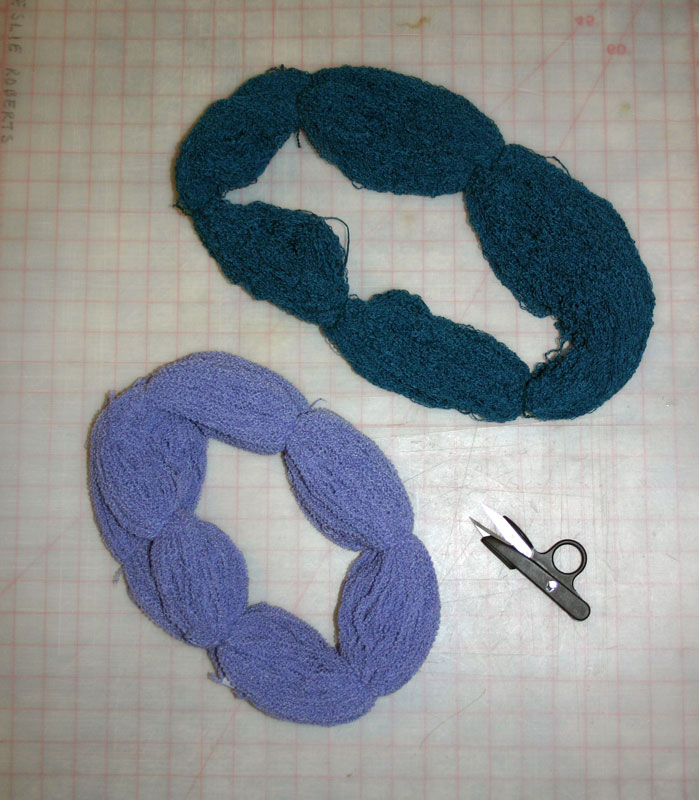
Here are skeins of the periwinkle and teal in 2 ply before and after washing. You can see how much they relaxed. Some knitters frog and knit as they go but I like to take the time to skein, ply and wash the yarn. It helps the kinks relax and I get a more accurate stitch gauge.


I'm thinking of making this Tuxedo vest. I haven't swatched yet, but I now have enough yarn to hold six strands together for a worsted weight. I need 700 yards.


What I have is 300 yards of 2 ply in five colors, more than enough. I can see the color play in my mind, but this is new to me so I'm going on instinct. I decided to draft a color sample.


Now that's cool. Time to knit a new swatch. This whole thing may not turn out the way I hope, but I'm learning a lot, and... nothing ventured, nothing gained.
 

Manzanita Blossoms


Knitted Tee Shirt Rug

Last fall I made a tee shirt rug for a Christmas gift. Now I can show the pictures! I cut the strips 1 1/2” and got approx 32 yards from one tee shirt, size large. I cut across at the arms and included the sleeves. I followed this tutorial to make my 'tarn' - tee shirt yarn, though I used my rotary cutter and ruler to cut the strips. It was stretchy and soft, worked up fast and was MUCH nicer to knit than my cotton rag rug.

Garter stitch - knit every row
Needle size: 15
Strip width: 1 1/2”
44 stitches equals approx 24 inches, the width of the rug
18 stitches to a yard of tarn


Many of the tee shirts were in our rag bag, some I bought for 25 cents at a rummage sale. I found the well used tee shirts were softer and knit up nicer.


Swatching


I  made the tarn one tee shirt at a time, joining the new color as the old one ran out, and I didn't roll it into a ball because it was a lot easier to work with laying loose. As I knit I would occasionally untwist the tarn yet to be knitted. That helped it lay better when it was knitted.


Each strip of color is approximately one large tee shirt. I decided to keep the width of the colors about the same so when I made tarn from an extra large I ended the color and used it again later. Wow, we had a lot of greens and purples in our rag bag!


It was a little tiring on my hands, so I knit two row a day from mid October to mid December. Yay, finished with time to spare! It's thick and stable and fun. If I was going to do it again I would probably cut the strips 1". I have no idea how washable this is.

Happy Valentine's Day!

I made a 2-1/2" patchwork heart block. The pieces each measure 1/2".


Here is the thumbnail draft. 


Next I laid out 1-1/2" fabric squares on gridded fusible interfacing. It's so much bigger than the finished block because I sew half inch seams and trim to 1/4". For full instructions visit this post.


I didn't take a picture of the next step, but using a craft knife and a ruler I cut a window in the card. The picture above shows the block from the inside. After it's in position I used double-sided tape to hold it in place.


Then I covered the block with plain paper for a finished look.


Thursday, January 19, 2012

Soft Memory Cards

Did you ever play the Memory game, using a standard deck of 52 playing cards? Any number of people can play. You place all cards, face down on the table. Each person turns over two cards, one at a time and leaves them in their place. If they don't match, they are turned face down again. If they do match, the person gets another turn. The one with the most matched pairs at the end of the game wins.

I saw the idea for fabric memory cards at Purl bee. If you want to make these, please read those instructions. I changed the directions a little to make them easier.


You will need 42 - 2-1/2" squares, two each of cotton fabric, medium weight fusible interfacing, 8 ecru felt squares 9" x 12", a small amount of clear template plastic, a black permanent marking pen, a craft knife, a sewing machine, ecru thread to match the felt and rotary cutting mat, cutter and rulers.  

I chose 21 fabrics for a set of 42 memory cards, but you could make more or less if you want. Cut the squares 2-1/2". I went to my scrap box of 2-1/2" squares and pulled pairs.


Instead of cutting squares of the fusible interfacing and fusing them to the fabric squares one at a time, I placed the squares on a sheet of interfacing and used a pressing sheet to keep the bottom of my iron clean, fused all 42 squares at once.


Cut the squares apart using your rotary cutter and ruler.


Yes, these instructions are left-handed :)

For both the front and back felt squares, you'll need 42 cut 3". Cut 21 from the felt, these will be for the fronts, set aside. Before you cut 21 for the backing squares, fuse the 9" x 12" felt pieces to the interfacing, then cut 21 squares for the backs.


Next make a 3" keyhole template from the clear plastic. Mark the inner square with a fine tipped Sharpie or other permanent marker, 1/2" in from the edge, making a 2" square. Carefully cut this out with a sharp craft knife.


Place the template on a 3" felt square that does not have interfacing on it and mark the corners with a pen. I tried pencil, it didn't show. I also tried a water soluble marker and it spread out too much on the felt.


When you cut out the center, cut on the outside of the pen marks. This is the wrong side and will be face down when you assemble your squares.


To sew them together, place a fabric square right side up on the wrong side of a backing square. The backing squares have the interfacing on them. Lay a top piece over and pin at the top.


Adjust your stitch length to allow for sewing through two layers of felt. On my Janome MC, that was 3.3, instead of the usual 2.3 I use for patchwork. Sew a quarter of an inch around the outside of the square first, pivoting at the corners and taking a back stitch at the end. Cut the thread, lift the presser foot and move the square over to the edge of the opening. Top stitch a scant 1/8" in from the edge around the opening, pivoting at corners and back stitching at the end. Remove from the machine and trim threads close to the front and back. I found the Janome  thread cutter made this part of the project go fast.


Using your rotary cutter and ruler, trim the squares a scant 1/8" on all sides, squaring them up. Now you're ready to lay them out.


This is a great game to play with your kids or grandkids. It's also great for anyone working to sharpen their memory and visual-spatial skills. Try it, just for fun!

The Not-so Felted Slipper


I put the slipper in a zipped pillow case to catch the lint and washed it FIVE times in hot water, with a little bit of detergent and the wash cycle set on heavy-duty. I checked it after each cycle.


Here's about half of the lint. It's better to catch it somehow than to let it clog the washer's drain pipe.


It shrank and felted but as you can see, not nearly enough to make a size 8; or even a size 13! I'm willing to explore and experiment if I learn something along the way; in this project I got better at the Kitchener stitch used to seam the bottom. And I learned if I'm going to veer from an established pattern, I can expect mixed results. More swatch testing was probably in order for this project. So I guess it's back to the drawing board.

Wednesday, January 18, 2012

Someone Has a Sense of Humor


Another Virginia Cowl

Once I finished the Virginia cowl for my Mom's gift, I began one for myself using the reclaimed merino. 

It seemed too tight on size 8 needles, so I changed to size 9. But when I blocked it, it grew an inch in width. I think that's because the reclaimed wool relaxed. This is a good lesson for me, always prewash your reclaimed skeins to get the kinks out!


It's soft and fun, but cashmere is definitely snuggier than merino. :)

Friday, January 13, 2012